

We’ve all done it. Dumped years of work, personal correspondence, irreplaceable files into a cloud folder, trusting it’s safer there than in a drawer at home. It feels like a digital fortress. A Japanese manga artist just found out, with a rather rude awakening, that his fortress had a landlord with a hair-trigger alarm system.
What Actually Happened
A creator with decades of work to his name backed up a panel from his own uncensored manga to a private Google Drive. Not shared. Not public. His own archive.
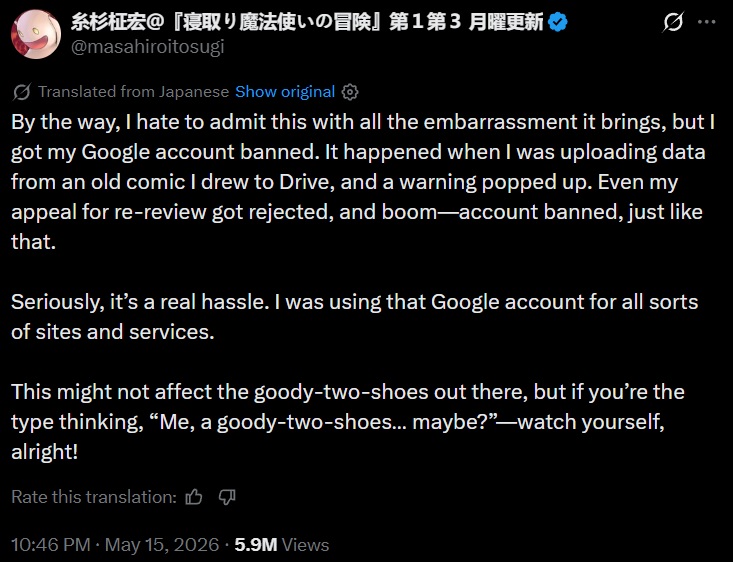
Google’s automated systems flagged it. In a swift, automated stroke, his entire digital existence was evicted.
- Gmail — gone
- YouTube history — gone
- Purchased apps, connected services — gone
- His primary work communication tool — severed overnight
A digital identity, simply wiped.
Think of it not as a ban, but as a corporation repossessing your house because they didn’t like a painting you hung in the locked basement.
The Appeal That Went Nowhere
The artist tried to explain — the material was private, his own creative work, never shared with anyone. The algorithm rejected his appeal instantly. A conversation with a wall.
His warning to the community was stark: if you have risqué files or sensitive material saved on your drive, you could be next.
When Artists Realized the Cloud Isn’t a Safe
The fallout in online art communities was immediate — and telling. Paranoia spread through illustration forums as users confronted an uncomfortable truth we’d all chosen to ignore:
The cloud is just a computer you don’t control, sitting in a building you’ll never see.
If the platform’s terms of service are the local laws, your data lives there on a perpetual tourist visa — revocable at any time for any perceived infraction.
The Regression Nobody Expected
The practical advice now is fascinating in its backwardness.
- Password-protected compression for sensitive work
- A return to physical hard drives — those “foolproof” objects we so eagerly cast aside
We traded the certainty of a tangible object for the convenience of access, and are now rediscovering the value of a lock you can hold.
This Is Bigger Than One Artist
This isn’t about one mangaka or one platform. It’s a case study in the concentration of power.
A single entity can, with no human oversight, sever a person from their communication, their creative archive, and their commercial tools. The service is free — but the cost of non-compliance is total.
The Part That Should Unsettle You
We outsource our memory and our work to these systems, but they operate on a moral and aesthetic code we never signed.
The artist’s private sketch is treated with the same zero-tolerance policy as public hate speech.
No distinction. No nuance. No mercy.
So consider this — if your life’s work or core communication is tied to a service you don’t pay for with cash, what are you actually paying with? And does the convenience of seamless cloud access today make us more vulnerable to a sudden, absolute loss of control tomorrow?




Leave a Comment