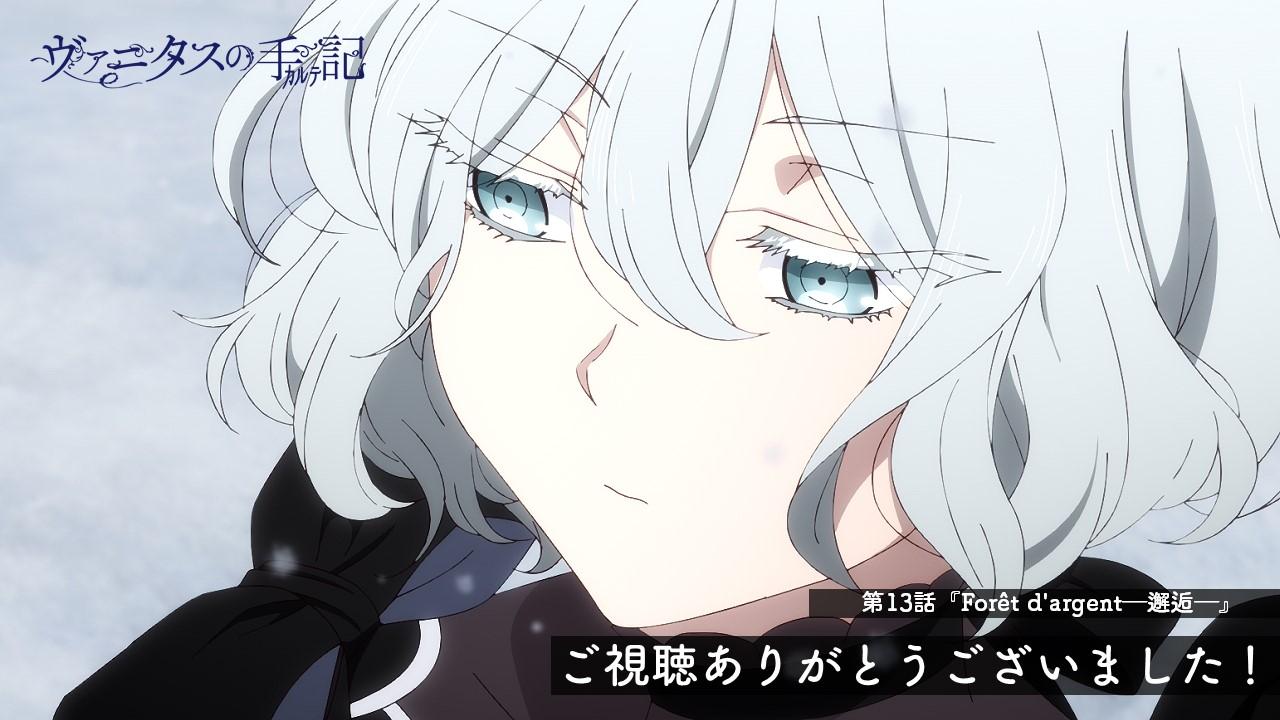

This Vanitas no Carte review contains spoilers. If you haven’t seen the chapter yet, we encourage you to do so and then come back to read the review.

Chapter 13: “Forêt d’argent”
In earlier episodes, Vanitas believes that Noah is in danger. However, she finds him sound asleep. The young vampire has amnesia, he doesn’t remember the blood oath he had to make to Ruthven, so it’s all a little scare.
Then Dante appears with news: the legendary beast of Gévaudan has reappeared. Without hesitation, Vanitas and Noé take a train to go to the crime scene. This legend has its origins in the 18th century and it is said that the beast killed more than 100 people including women and children. In addition, a detailed description of their physical appearance is provided. Finally, there is mention of the existence of a witch who would inhabit the same Silverpine Forest where the monster would reside. All of this points to a possible vampire bearer of the curse.
While investigating in the woods, Noah gets lost. Suddenly everyone is transported to a winter in the 18th century. There they meet the paladin Astolfo, who goes into battle with Noah. Just then, the beast bursts in and everyone is reunited. Jeanne, who is also there, seems to know the vampire behind the beasts and is determined to kill him, but Vanitas wants to heal him. Suddenly the entourage of Charlatán and Naenia appears; Vanitas tries to use the book, but someone cuts the chain and everything goes black. Noah lies unconscious in the snow in front of a young woman named Chloe and her helper.
Analysis: resuming the project

Vanitas without a card unexpectedly ceased broadcasting at the end of season one, leaving us with honey on our lips. Whatever the reasons, we just hope it was for the best, that the care in animation and faithfulness to the manga matched the quality of the first twelve episodes.
Sure enough, the anime was enthusiastically received. Overall, it met manga fans’ expectations and greatly increased the number of fans. With the opening of the Gevaudan arc, after this break the minimum is to continue in the same way as before and although we have already experienced exceptional scenes, we wish for a season as sublime as the first.
On the other hand, although I left my opinion and analysis of the essential issues in the reviews of the other seasons, apart from the heat and novelty of the product, I can draw a number of conclusions: Vanitas without a card He made a great adaptation of a manga whose narration was already good, an improvement over other works by Mochizuki, and relying on it, an anime faithful to the original was achieved. In addition, the animation is full of beauty. The music, the colour, the movement, the costumes and the landscape move. The French expression “C’est superbe!” comes to mind quite appropriately.
Finally, in this sense, the second season has known how to unfold all the charm of the series for the time being. The action scenes, humor and reflection follow one another in a balanced manner and the chapter is well structured. The opening and ending follow the marked trail and avoid spoilers (it’s a classic anime cliche), so they opt for everyday or sensual scenes.
Madness and theatricality in Astolfo and other characters

The most interesting theme I can glean from this chapter is without a doubt the insanity and emotional exaggeration of no fewer characters Vanitas without a card. In the end, all negative emotions and Vanitas’ own crusade are associated with insanity. At times it seems that Mochizuki wants to tell us that evil has madness as its source and that ultimately deepens its roots in pain.
Our protagonist is a doctor of madness, but this is not only in the malnomen of a vampire, but also embodied in evil people. So the character of Astolfo, Roland’s archenemy, because he is at peace with himself. Astolfo, on the other hand, is insane and therefore evil, due to the inner torment that triggers it. Enjoying violence, theatrics, and other antagonistic platitudes in anime aren’t new, but being Mochizuki I like to think it gives it meaning.
Other characters like Naenia and the Charlatán parade welcome the masquerade and the game, they feed on madness and go to her for that reason. Perhaps, and inadvertently, we have stumbled upon what may be the grand theme of this work: Does pain ignite madness and is this the source of evil?
Finally
Vanitas without a card he resumes his broadcasts and inspires us again. Gévaudan’s arc is of unusual complexity, making his storytelling a challenge in its own right. However, the story is well developed and consistent with the above, the next few chapters are promising.





Leave a Comment