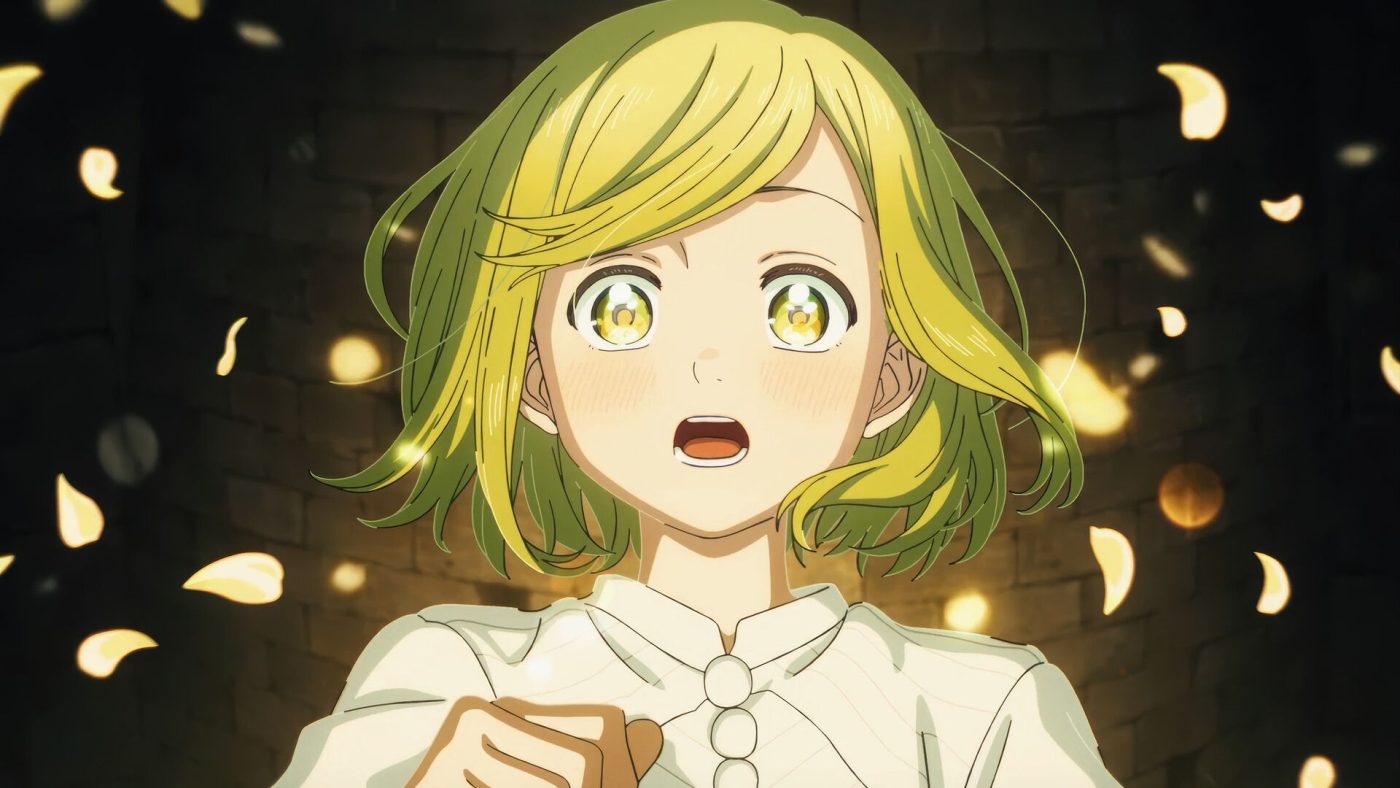

Seven years. That’s how long Jacob laboured for Rachel in the Old Testament, how long one waits for a London landlord to fix a boiler—and, according to a whisper that somehow grew itself a suit of armour, the time the team behind Witch Hat Atelier supposedly spent hunched over light tables like monks in a scriptorium.
They didn’t. The staff have stepped out to gently swat the rumour aside. The whole saga did not stretch across a biblical epoch. The correction is almost as telling as the myth itself.
制作期間について良く聞かれるので、
なかなか詳細については言えないのですが、また裏話を少し。アニメ化発表は2022年にしているのですが、BUGFILMSは最初から関わっていた訳ではありません。
縁があって正式に制作に参加したのは2023年〜です。
なので実質の制作期間は約【3年半】ですね。…— 児島宏明@BUG FILMS (@kojima2019) May 5, 2026
Like many of you, I’ve been repeating that rumor about Witch Hat Atelier being in production for seven grueling years. It sounded insane, almost mythical – a studio sacrificing everything for perfection. I spread it without checking, and I’m sorry.
Producer Hiroaki Kojima recently stepped forward to clear the air, and I want to humbly share the real timeline so we can all appreciate the truth.
The project was first discussed internally back in 2019, but that was just early planning. The anime was announced with great fanfare in 2022, but Studio Bug Films wasn’t actually involved from day one. Kojima himself only officially joined the production in 2023 through some good industry connections.
So how long did the actual animation work take? About three and a half years.
That’s still a massive amount of time – more than triple what a typical 12-episode season gets. This first season will have 13 episodes, and the team poured that extra time into achieving the breathtaking blend of 2D animation and 3D CGI we’ve seen in the trailers. They worked directly with original manga creator Kamome Shirahama to ensure every visual and emotional detail was perfectly adapted.
That perfectionism is exactly why they pushed the release from 2025 to 2026. They didn’t want to cut a single corner.
Kojima admitted this has been the most demanding project of his entire career, and he used his message to deeply thank his entire production committee. His only wish now is that we simply sit back and enjoy the art on screen.
So no, it wasn’t seven years of nonstop torture. It was three and a half years of intense, dedicated craftsmanship. I’m just grateful the truth is out, and I’ll be waiting patiently (and quietly) for 2026.
If this level of care becomes the new standard, we’re in for something truly special.
The Number Game
- Somebody drops a figure in a thread at half past midnight—seven years—perhaps a guess about animation gestation, perhaps a simple muddle with the manga’s publishing timeline.
- It lands with a satisfying thud.
- The number anchors itself in the collective consciousness like red wine on white linen.
- The exquisite filigree of Coco’s world demands an origin story of matching grandeur. We want to believe the beauty was bought with tears.
The production team have quietly reminded everyone that excellence and efficiency are not mutually exclusive.
There is no cosmic rule stating luminous art must gestate in a cellar for the better part of a decade. Sometimes a talented group simply shows up, does the work, and produces something brilliant on a sensible timetable. It is rather like discovering your hand-built walnut bookshelf was finished in a crisp fortnight, not the six-month odyssey you’d romanticised. The shelf still holds your books. The joints are still tight. You merely misread the sweat involved.
Why the Fairy Tale Wins
We are pattern-matchers, not forensic accountants. Once a narrative fits our emotional expectations—beautiful things require beautiful suffering—we are reluctant to swap it for a mundane truth. The staff’s clarification, polite and workmanlike as it was, simply lacks the cinematic heft of the original myth.
A fib travels round the world before the truth has got its boots on, particularly when the fib is this romantic.
There is a quieter upside here. In an industry where stories of endless crunch and burnout are depressingly familiar, the news that Witch Hat Atelier did not require a seven-year siege ought to come as relief. Nobody had to bleed for your enchantment. The magic arrived without the unnecessary theatre.
So the hat stays on. The spells still gleam. The only thing that disappears is the invented agony.
- If we are so eager to append suffering to the price tag of great art, what does that reveal about the stories we tell ourselves about work?
- Why do we assume the magnificent must always be the martyred?
- How many other “seven-year” legends are we carrying around that never happened at all?






Leave a Comment