

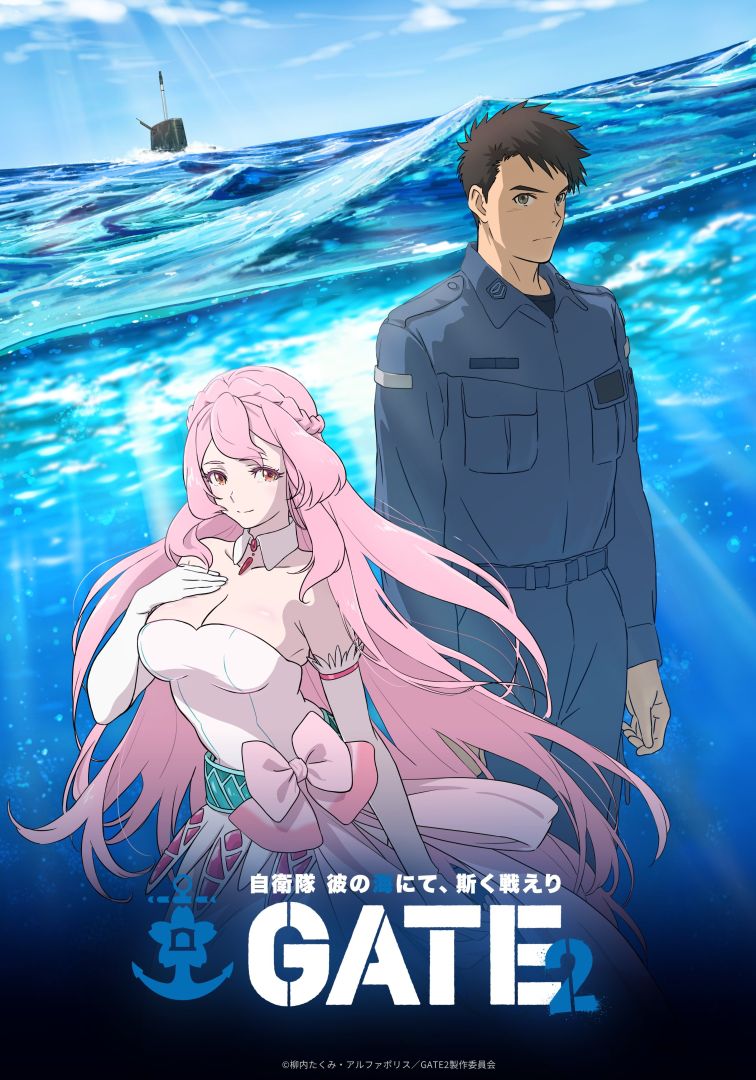
The expansive universe of Gate resurfaces with its sequel, Gate 2: Tides of Conflict, which unveiled a compelling first visual teaser this Friday. This new chapter shifts the focus to Japan’s Maritime Self-Defence Force, traversing expansive oceanic realms and departing from the land-centric battles of the original, thereby charting fresh narrative waters.
The Architects Behind the Sequel
Studio M2 spearheads production, guided by director Toru Takahashi. The series’ narrative and script fall under the stewardship of Tatsuhiko Urahata, who reprises his role from the inaugural season, ensuring continuity in storytelling depth. Character designs emerge from the skilled hand of Shigeru Fujita, bolstered by the collaborative efforts of Genco’s production team. Such a seasoned assembly suggests a deliberate intent to elevate the saga’s visual and thematic resonance.
A Phenomenon Rooted in Enduring Legacy
Gate: Jieitai Kano Chi Nite, Kaku Tatakaeri originated as a novel series penned by Takumi Yanai, with illustrations by Daisuke Izuka and Kurojishi. Serialised online from 2006 to 2009, it transitioned to print under Alphapolis in 2010. By June 2024, the franchise had amassed over 7.3 million copies in circulation, encompassing both physical and digital editions, underscoring its profound cultural imprint.
From Novels to Anime: An Evolving Saga
The manga adaptation, illustrated by Satoru Sao, commenced in 2011 and branched into spin-offs by 2015. This paved the way for the anime series, broadcast in 2015 and 2016, which entrenched Gate as a cornerstone of military fantasy. The sequel’s pivot towards maritime warfare and an examination of Japan’s naval capabilities represents a thoughtful progression, broadening the exploration of strategic and geopolitical themes.
Reflections on the Franchise’s Return
The teaser’s spotlight on oceanic skirmishes and the Maritime Self-Defence Force hints at a more profound engagement with Japan’s position in international affairs. It appears that this direction could illuminate the interplay between advanced technology, geographical challenges, and national ethos, fostering a narrative that feels both authentic and far-reaching. How might this maritime emphasis redefine the legacy of Gate for longstanding enthusiasts? In what ways could the series’ evolution prompt viewers to reconsider the dynamics of modern conflict?





Leave a Comment